
When most people Google “PDO threads,” they land on articles about lifting — and lifting alone. But here’s what those articles miss: there are actually three distinct types of PDO threads, each with its own technique, purpose, and ideal patient. Understanding the difference can help you walk into your consultation with better questions and clearer expectations.
Let’s break it all down.
What Are PDO Threads, and Why Does the Material Matter?
PDO stands for Polydioxanone — a synthetic material that’s been used safely in medicine for nearly four decades. If you’ve ever had dissolvable stitches after a procedure, you’ve already had it in your body. It’s considered one of the safest absorbable implants available.
When placed in the skin, a PDO thread gradually dissolves over four to six months, but its effects don’t disappear with it. As the thread breaks down, it triggers your body’s natural healing response — stimulating new collagen and elastin production that can visibly improve skin quality for up to 12 to 16 months. PDO threads also promote micro-circulation, improve tissue integrity, and help relax underlying muscle tension. Think of it as quietly rebuilding your skin’s internal support structure while you go about your life.
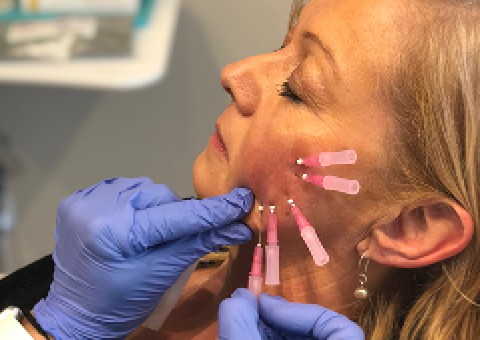
Type 1: PDO Lifting Threads
Lifting threads are what most people picture when they hear “thread lift.” These threads have barbs or cones along their length that grip the tissue and physically reposition the skin upward when pulled. They’re inserted into the subcutaneous fat layer — just beneath the skin — and work on two levels: immediate repositioning and long-term collagen stimulation.
The best candidates for lifting threads are patients with good overall skin quality and mild to moderate sagging. A great example would be someone with early nasolabial folds or mild marionette lines who wants a subtle but visible lift without surgery. If the skin is significantly loose or heavily damaged, lifting threads alone may not deliver the result the patient is hoping for — and we’ll always tell you that honestly at your consultation.
Type 2: PDO Smooth Threads
Smooth threads take a different approach entirely. Without barbs, they glide under the skin with minimal resistance and virtually no discomfort during insertion. Their purpose isn’t to lift — it’s to restore. Smooth threads act as a scaffold, encouraging collagen growth in areas where the skin has thinned or lost structure over time.
Because the results build gradually, smooth thread treatments work best as a series. We typically recommend three to five sessions spaced four to six weeks apart to see the full benefit. Target areas include crow’s feet, glabellar lines (the “elevens” between the brows), nasolabial folds, and fine lines along the sides of the face.
A practical example: a patient comes in with a deep crease between the eyebrows. BOTOX will soften the muscle movement that’s causing it, but the crease itself — carved in from years of expression — may not fully respond to Botox® alone. A series of smooth threads placed in that area works alongside the BOTOX to rebuild the tissue and smooth the crease from within.
Type 3: PDO Twist Threads
Twist threads are the most nuanced of the three. Their coiled, spiral shape creates significantly more surface area than a standard smooth thread, which translates to more robust collagen stimulation and more dramatic skin-tightening results. The tradeoff is that placement requires a higher level of technical skill and slightly more time in the treatment room — but in experienced hands, the added precision is well worth it.
One of our favorite applications for twist threads is lip border definition. Rather than adding volume with dermal fillers alone, twist threads can restore the natural edge of the lip, adding subtle definition and structure. They also work beautifully on areas of the body where skin laxity is a concern — the inner arms, knees, and abdomen — as well as for improving the texture and depth of acne scars.
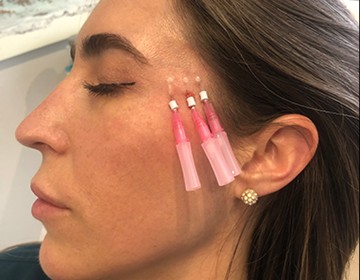
How PDO Threads Compare to Dermal Filler
Patients often ask how threads stack up against filler, and the honest answer is: they’re complementary, not competitive. A few key distinctions worth knowing — PDO threads are hydrophobic, meaning they don’t attract water, which reduces the risk of swelling that can occasionally occur with hyaluronic acid fillers. They also work at different tissue depths and layers, which means a skilled provider can use threads and filler together in the same appointment to address concerns that neither could fully resolve on its own.
In fact, one of the most common ways our patients incorporate threads is by adding a few smooth or twist threads at the end of a BOTOX appointment. It’s an easy add-on that layers long-term collagen support on top of the muscle relaxation BOTOX provides.
Featured Skincare Product

Renewal Facial Cream
Is a PDO Thread Treatment Right for You?
The best way to know is to come in and talk. PDO threads aren’t one-size-fits-all — the right type, quantity, and placement depend on your skin, your goals, and what other treatments you may already have in your routine. Our team has placed threads in virtually every treatment area and loves helping patients find the approach that makes the most sense for where they are right now.
We see patients at both our Camarillo and Ventura locations. Book a consultation online or Contact — we’re happy to walk you through it before you commit to anything.

